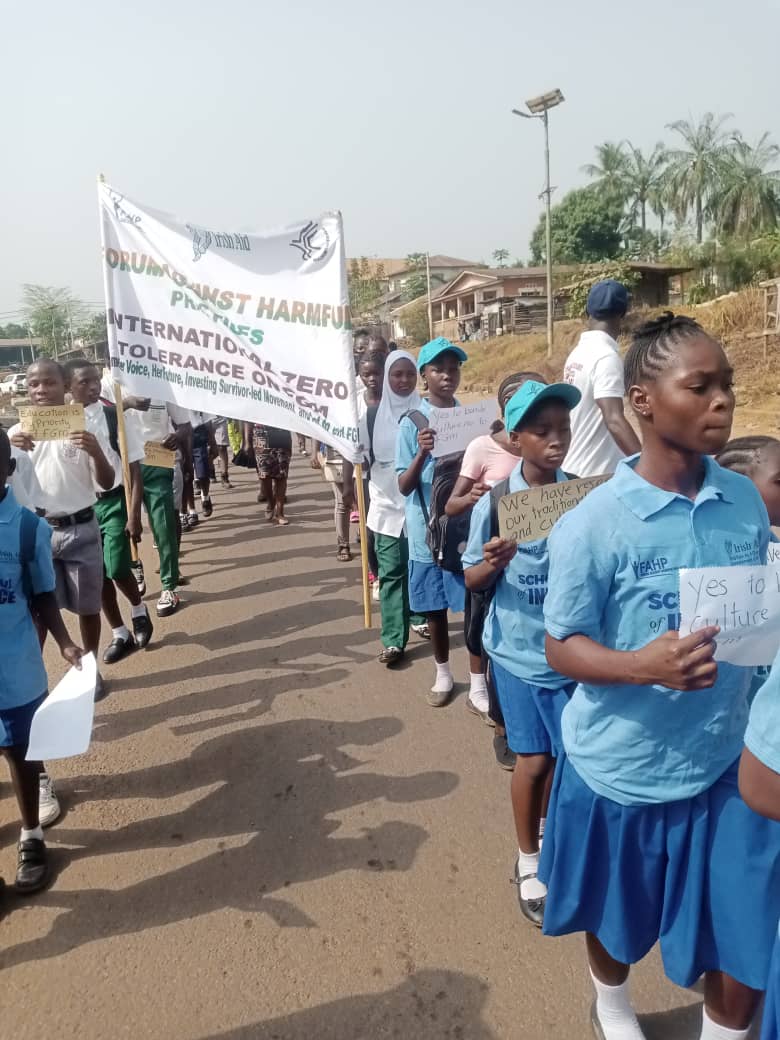
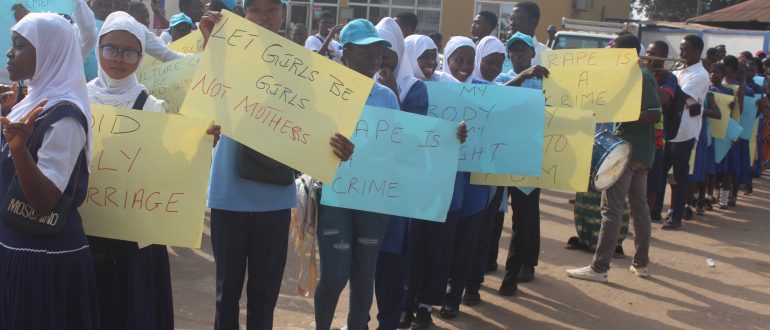
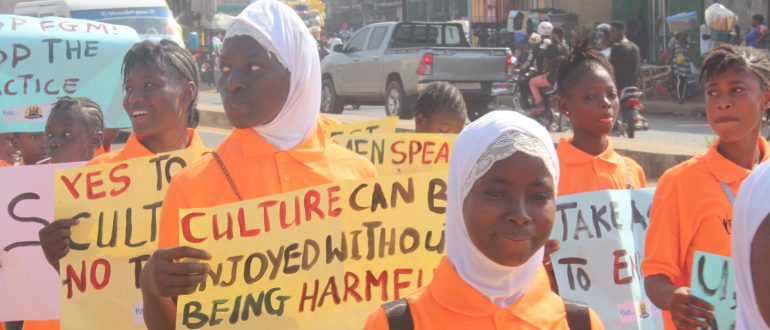
The Forum Against Harmful Practices (FAHP) in collaboration with the Ministry of Gender and children’s Affairs, Purposeful and Irish Aid has organized a float parade in Waterloo.
The theme of this year’s event is: “FGM is a Human Right Issue, End it.” The float/procession parade started from 5-5 place in Waterloo, through Tombo Junction and ends at Bassa Town Field where several statements were made by key stakeholders.
In her welcome address, the Executive Secretary FAHP, Madam Aminata Koroma, expressed thanks and appreciation to individual partners who were representing various organizations on the occasion.
She also thanks the sponsors especially stakeholders of Purposeful organization, representatives of Ministry of Gender and members of the media who were part of the colourful ceremony.
In her statement, the Chairperson of FAHP, Madam Rugiatu Neneh Koroma, disclosed that Waterloo is a FGM prone community where at least every three months women and girls reportedly died while in the bondo bush.
She said over the years nobody talked about FGM in public forums but FAHP and other partners have been able to break this barrier.
Speaking on the challenges, Madam Koroma said the big challenge as a Coalition is the funding gap. She revealed that FAHP needs “consistent funding” to ensure that FGM totally ends in the country.
Madam Rugiatu Neneh Koroma called on international partners and other big organizations that deal with FGM issues to direct their funding to local organizations in order to heighten the fight and work to end the practice of FGM in totality.
Madam Koroma also pleaded to the government to sign the FGM National Strategy, a major strategy which aims to end FGM practices in Sierra Leone.
She also expressed the challenge they are faced with on the side of regulatory powers to make laws regarding the end of FGM in Sierra Leone.
Koroma said the bloodless rite sponsored by Purposeful was a pilot phase that many people have welcomed not only in the piloted District but also by everyone across the nation.
She urged the Ministry of Gender and the government to take what she referred to as ‘bloodless bondo initiative’ in other districts in order to end the harmful practice of FGM.
Madam Koroma further said that the government has worked relentlessly to provide the 30% quota for women, working to ensure land rights to women but now as women, she added, they needed protection which is their key motive to achieve and that she continued: “one among the protections is eradication of FGM”.
In her statement, the Legal Adviser for Purposeful, Nicky Spenser-Coker, says they fight to end anything that hinders women progress in society and that they are always ready to fight and end FGM.
Barrister Coker said all the countries in Africa have signed the Maputo Protocol and other Conventions and stressed that FGM practice is a human right violation on women and girls and so it must end in Sierra Leone.
“No one works towards ending bondo society in the country. As Sierra Leoneans we believe in bondo, we believe in sexual right and we also believe in violent free society,” she said.
She went on to say that as campaigners advocating ending FGM is their key aim to achieve as Sierra Leoneans.
Nicky Spenser-Coker urged for collaboration and pleaded to Waterloo residents to abandon FGM as it has economic, social and health implications for women and girls in society.
In his submissions, the Civil Society Organization representative in Waterloo, Mr. Salim Conteh, said there are several cases of FGM in Waterloo.
Mr Conteh said as CSOs in the district, they observed that most incidences of subjecting women and girls into FGM in Waterloo are sponsored by people of high authority.
He urged FAHP to continue with the civic education in these deplorable communities to ensure that women and girls know the effects of FGM in the country.
Making her keynote address, the Director of Gender Affairs, Ministry of Gender and Children’s Affairs, Madam Mariam Goodie Sowonie, on behalf of the Ministry of Gender, expressed her ministry’s commitment and dedication to promoting and protecting the rights of women and girls in the country.
She expressed thanks to all donor partners for sponsoring the ‘float parade’ and made reference to the International Human Right Day, a day that she said would help to address issues of women and girls in the country.
She also spoke on the theme and said: “FGM is a human right issue and it must be stopped.”
Mariam Goodie Sowonie also said that FGM has negative impacts on the health of women and girls in the country, adding that the practice also raises issues of vulnerability for women and girls in society.
She maintained that the Ministry acknowledges that Sierra Leone has signed the Maputo protocol and CEDAW, adding that such conventions are signed to end the harmful practices of FGM.
Several representatives including officials of the Ministry of Social Welfare made salient statements.
Mr Ishmael Cole who gave the vote of thanks expressed thanks to all outstanding local organisations, students and other international partners organisations that took part in the float parade ceremony and he called for all to work towards ending FGM in Sierra Leone.